
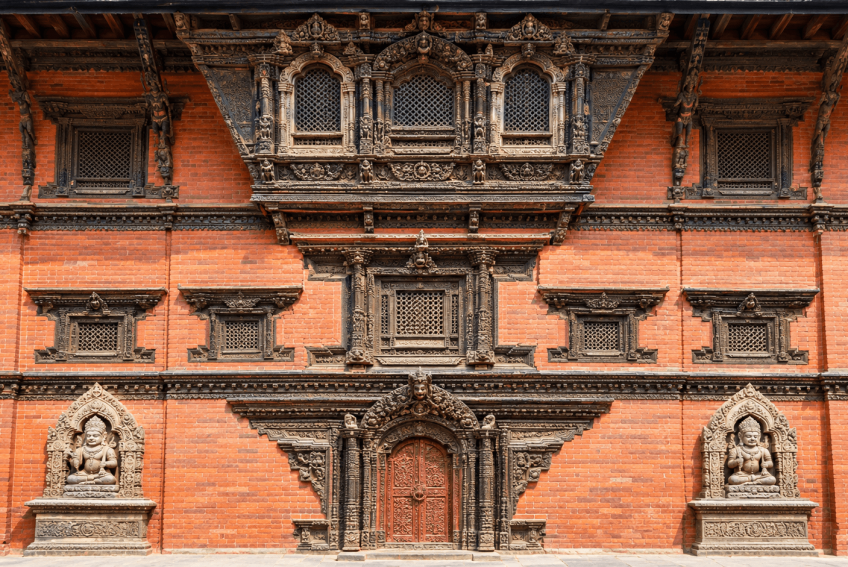
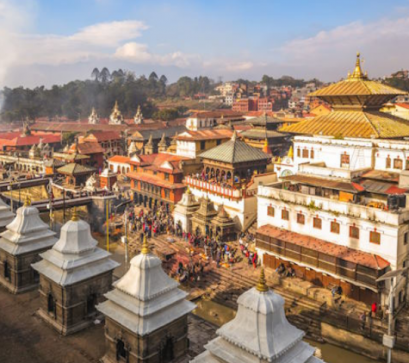
Most travellers see only the public face of these cities: the temple-lined Durbar Squares that draw the crowds. What they miss is a second layer, reached through narrow, low doorways set between ordinary shops, with no outward sign of what lies behind. These are bahals, and their smaller version, bahils courtyards built centuries ago as Buddhist monastic complexes, each centred on a stupa or shrine and ringed by carved wooden windows. Patan alone holds more than 130 of them, over half the total found across the Kathmandu Valley, part of why the city is known as Lalitpur, "the city of fine arts."
Patan's courtyards sit inside a web of narrow, winding lanes, a layout originally built for defence during the Malla era, when the valley's three rival kingdoms were often at odds; the tight corners made the streets impossible to charge on horseback. The same design keeps the lanes shaded and cooler than the open roads outside.
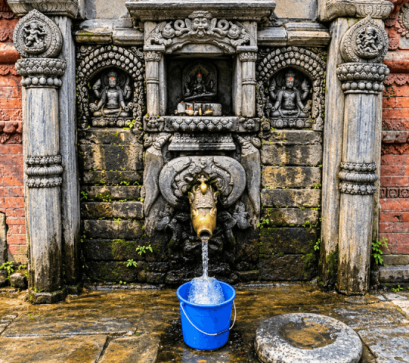
Notable stops include Hiranya Varna Mahavihar, a 12th-century monastery sheathed in gilded copper known as the Golden Temple; Rudra Varna Mahavihar, or Oku Bahal, considered Patan's oldest monastery; Kumbheshwar, home to the city's only five-storey temple beside a spring-fed pond; and Sundari Chowk, the sunken 17th-century royal bath now part of the Patan Museum grounds.
Bhaktapur, a short distance away, is the best-preserved of the valley's former royal cities. Its Durbar Square holds the Nyatapola Temple, Nepal's tallest pagoda, and the 55 Window Palace, prized for its carved wooden windows. Away from the square, residential bahils near Taumadhi and Dattatreya squares remain in daily use by local families rather than set aside for visitors.
Both cities are working communities, not museum pieces: Patan is still a centre of bronze and metalwork, Bhaktapur of pottery, with trades passed down over generations. The 2015 Gorkha earthquake damaged much of this heritage, and restoration using traditional materials has continued since.
None of the bahals charge entry, though the ticketed Durbar Squares and the Patan Museum do. Early mornings or Saturdays, Nepal's weekly day off, are the quietest times to visit, with better light for photography inside the shaded courtyards. A guided walk typically runs two and a half to three hours and costs $15 to $50, or can be done free with a self-guided route and a decent map. The walk pairs naturally with a stop at Changu Narayan, regarded as Nepal's oldest Hindu temple, and with local Newar food Bhaktapur's juju dhau yoghurt, bara, and chatamari are worth building time around.
Wear shoes that come off easily, since many courtyards require it at the entrance, and keep voices low these are residential and religious spaces, not exhibits. Carry small cash for entry tickets and refreshments, and expect narrow, uneven lanes that reward slow walking.


 (1).png)